A planet around another star
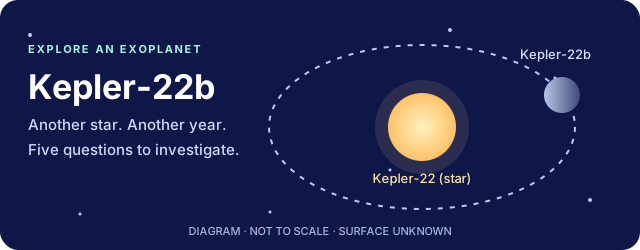
An exoplanet is a planet beyond our solar system. Kepler-22b orbits the star Kepler-22, rather than our Sun. The star and planet have similar names; the “b” identifies the planet. [3]
Read the lesson or watch the video, then take the five-question quiz.
LOOK CLOSER / WORLDS BEYOND OUR SUN
What can starlight tell us about a planet we cannot see up close? Watch the video, explore five facts, then test your knowledge.
Explore the evidence ↓
OBSERVE · INVESTIGATE · TEST YOUR KNOWLEDGE
Read these five facts or watch the video. Both cover the concepts assessed in the quiz.
WATCH / LESSON VIDEO
Choose to read the lesson or watch the video. This video walks through all five facts below.
An exoplanet is a planet beyond our solar system. Kepler-22b orbits the star Kepler-22, rather than our Sun. The star and planet have similar names; the “b” identifies the planet. [3]
An orbital period is the time needed to complete one orbit around a star. Kepler-22b takes about 289.9 Earth days, usually rounded to 290 Earth days. That is one year on Kepler-22b. [1]
The habitable zone is a range of distances from a star where liquid water could exist on a planet’s surface under suitable conditions. Kepler-22b orbits in this zone. Its atmosphere and other conditions still matter. Being in the zone does not prove that a planet has liquid water or life. [4]
NASA’s Kepler telescope detected the planet using the transit method. A transit happens when a planet crosses in front of its star from our viewpoint. The planet blocks a little starlight. Repeated dips in the star’s brightness reveal the planet and help scientists measure its orbital period. [5]
Composition means the materials something is made of. Scientists do not yet know whether Kepler-22b is mainly rocky, gaseous, or liquid. An illustration of oceans or clouds is a possible interpretation, rather than a photograph or confirmed map of its surface. [2]
CHECK YOUR UNDERSTANDING
Five questions · Grades 5–8 · No timer. Read the lesson or watch the video, then select one answer per question. Your results download as a PDF for your homeschool portfolio.
Take quiz →