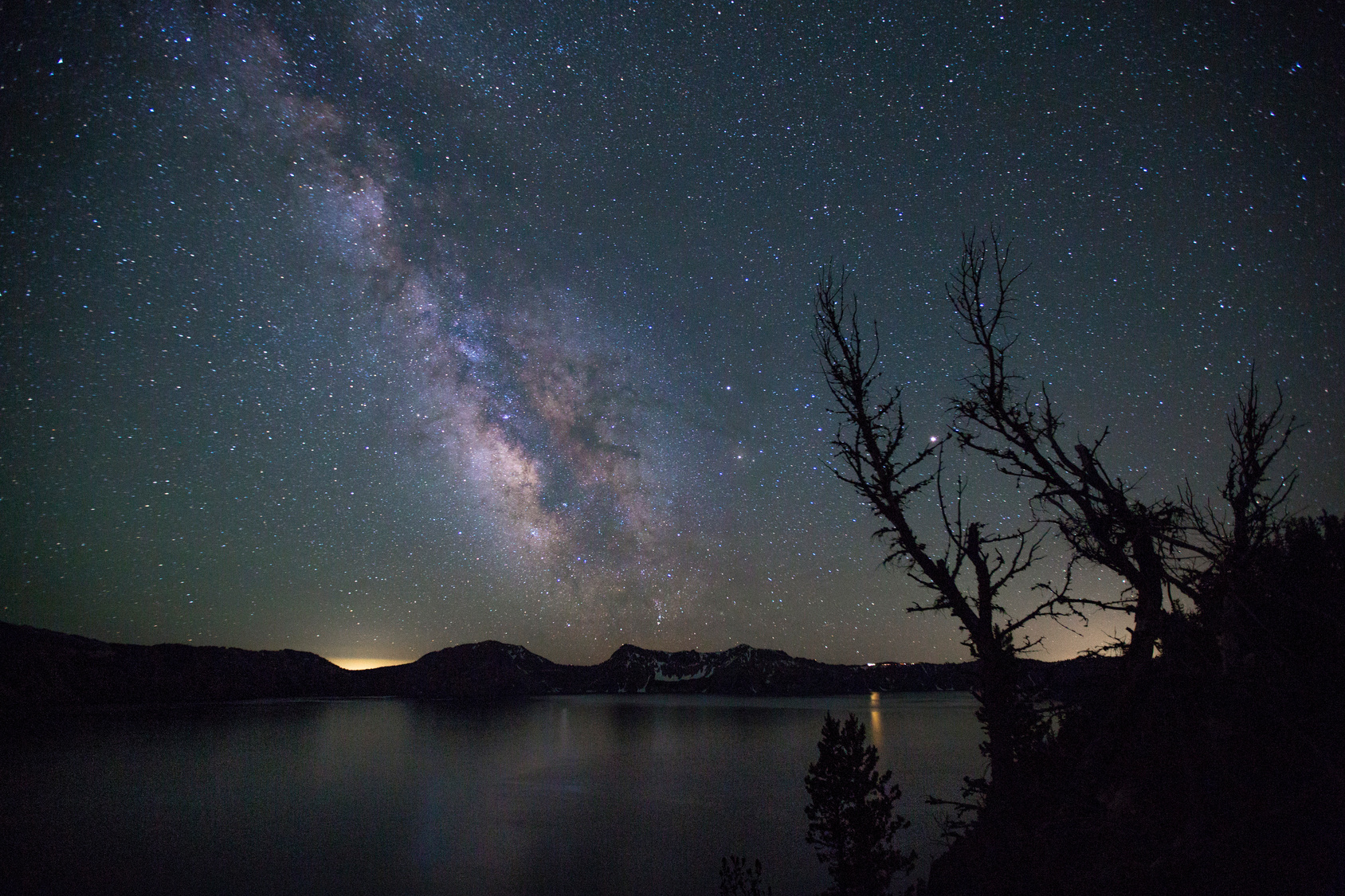
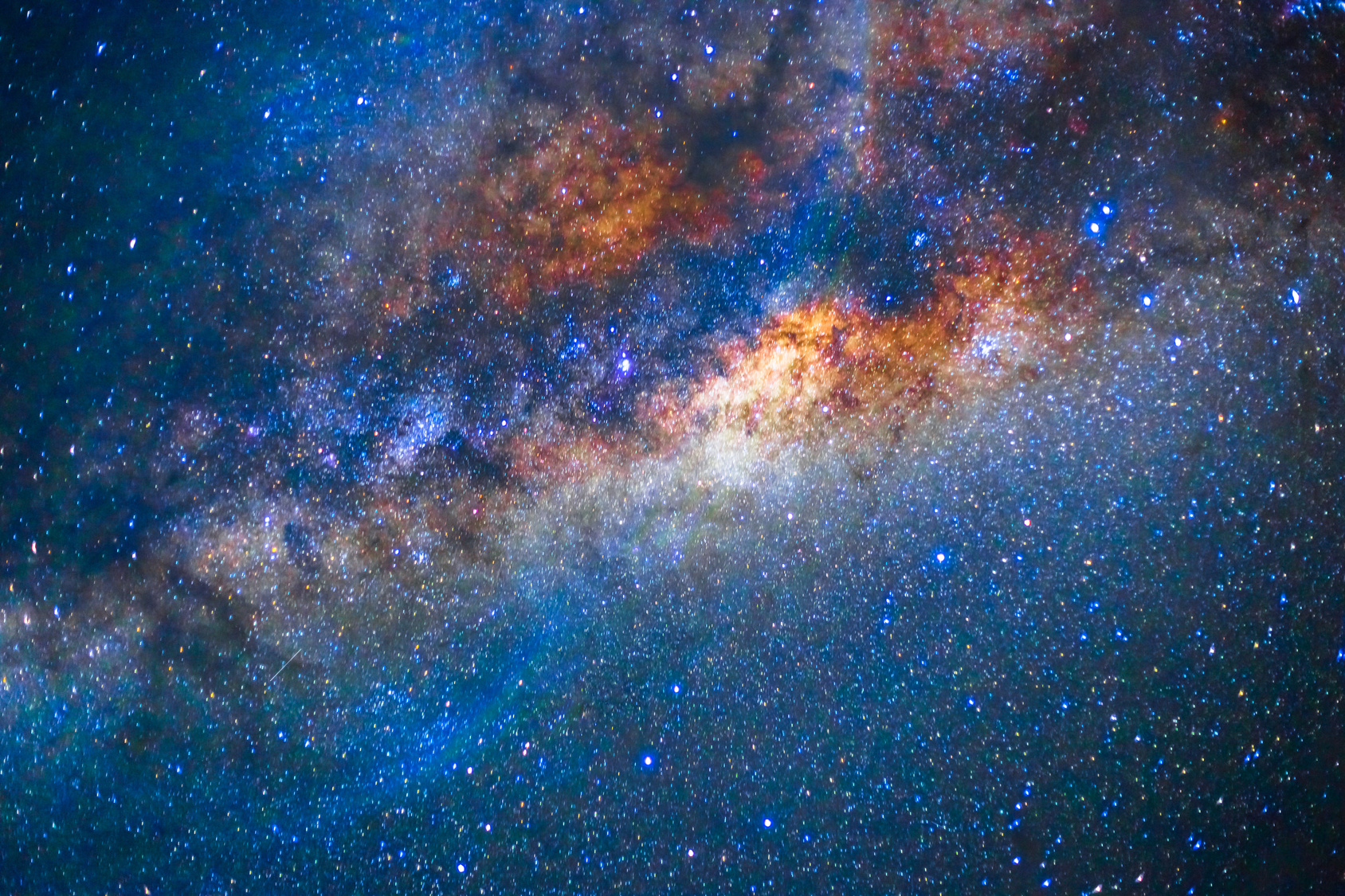
Every star you see at night is a distant sun. In this lesson you’ll learn what makes a star different from a planet, find our solar system’s address inside the Milky Way, discover which stars explode as supernovas, and see how gravity holds whole galaxies together.
Choose to read the lesson or watch the video. This video covers what makes a star, our address in the Milky Way, supernovas, why our Sun won’t explode, how gravity holds galaxies together, and the main types of galaxies.
Read the video as text
Stars vs. planets: a star is a giant ball of hot gas. Nuclear fusion in its core makes its light. Planets shine by reflecting a star’s light. Our Sun is a star.
Our address: Earth → solar system → Orion Arm → Milky Way. One trip around the center of the galaxy takes about 230 million years.
Supernovas: a star needs more than about 8 times the Sun’s mass to explode. It runs out of fuel, its core collapses, and the blast spreads elements like iron into space. That material can end up in new stars, planets, and us.
Our Sun won’t explode: billions of years from now it will swell into a red giant, then shrink into a small, Earth-sized white dwarf.
Gravity: gravity pulls things with mass together. Stars in the outer parts of galaxies move surprisingly fast, so scientists think invisible dark matter adds extra pull. Ordinary matter is about 5% of the universe; dark matter is about 27%.
Galaxies: there are billions of them: spiral, elliptical, and irregular. A galaxy has no solid edge; its parts fade out at different distances.
01 / STARS AND PLANETS
What makes a star different from a planet?
A star is a giant ball of hot gas, mostly hydrogen with some helium. Deep in its core, crushing pressure and heat squeeze hydrogen nuclei together to make helium. This is called nuclear fusion, and it releases the energy that makes a star shine. [1]
01
A balancing act
Gravity pulls a star’s gas inward. Energy from fusion pushes outward. While the two stay balanced, the star stays steady. [1]
02
Planets don’t make their own light
A planet does not run on fusion. Planets like Earth and Jupiter orbit a star and shine because they reflect that star’s light.
03
Mass decides a star’s life
A star’s mass controls how fast it uses its fuel. Massive stars burn out in a few million years, while some small stars can shine for trillions. [1]
04
Our Sun is a star
The Sun is a star roughly halfway through the steady, hydrogen-fusing part of its life. [1]
02 / OUR PLACE IN SPACE
Our solar system’s address in the Milky Way
Our solar system is the Sun and everything held to it by gravity. It sits inside the Milky Way, a barred spiral galaxy, in a small, partial arm called the Orion Arm (or Orion Spur), between two larger arms. [3]
Our solar system travels around the center of the Milky Way at about 515,000 mph (828,000 km/h) and takes about 230 million years to make one trip. [3]
03 / SUPERNOVAS
Which stars explode, and which don’t?
A supernova is a giant explosion at the end of some stars’ lives. It can briefly outshine an entire galaxy. But not every star becomes a supernova. A star needs more than about 8 times the Sun’s mass to end its life this way. [2][7]
MASSIVE STAR · CORE-COLLAPSE SUPERNOVAIllustration · not to scale
1 · A massive star runs low on core fuel
Layers of material surround an iron core. Fusion in that core can no longer provide the pressure needed to resist gravity.
This example leaves a neutron star. The animation slows and compresses events so you can follow the sequence. NASA source [12]
1
A massive star runs out of fuel
Massive stars fuse heavier and heavier elements in their cores until the core fills with iron. Fusing iron takes in energy instead of giving it off, so fusion can no longer hold the core up. [1]
2
The core collapses, then rebounds
Gravity crushes the core in an instant. The core bounces back, sending a powerful shock wave outward that blasts the star apart. [7]
3
Star stuff spreads into space
Supernovas scatter elements such as iron into space. That material can end up in new stars, planets, and even in us. [7]
Another kind: a white dwarf in a pair of stars can pull material from its partner until it explodes too. [7]Still a mystery: scientists use supercomputers to study exactly how a collapsing core turns into an explosion. [10]
04 / GRAVITY · GRADES 6–8
How gravity holds a galaxy together
Gravity is a pulling force between all objects with mass. The more mass objects have, the stronger the pull, and the farther apart they are, the weaker it gets. Gravity keeps planets orbiting the Sun, and it keeps the Sun and billions of other stars orbiting the center of the Milky Way. [11][5]
A MYSTERY IN THE OUTER STARS
Stars move too fast
In the 1970s, astronomer Vera Rubin found that stars near the edges of spiral galaxies moved as fast as stars closer in. The visible stars and gas didn’t have enough gravity to hold them, so something unseen had to be adding extra mass. [4]
INVISIBLE GLUE
Dark matter
Scientists call this unseen material dark matter. It doesn’t give off, reflect, or block light, but its gravity helps hold galaxies together. Ordinary matter is only about 5% of the universe; dark matter is about 27%. [4]
05 / GALAXIES
Every galaxy is its own system
A galaxy is a huge system of stars, gas, dust, and dark matter held together by its own gravity. Galaxies range from about a million stars to a trillion. [6] The Milky Way is just one of billions. [5]
🌀
Spiral
A flat, spinning disk with curving arms, like the Milky Way. [5]
No clear shape, often because a nearby galaxy’s gravity tugs on it. [6]
↔
Separate systems
Galaxies are separated by enormous distances. In the 1920s, Edwin Hubble showed that the Andromeda “nebula” is actually its own galaxy, far beyond the Milky Way. Galaxies can still interact and even merge. [6]
06 / ENRICHMENT · GRADES 7–8
Where does a galaxy begin and end?
A galaxy has no solid edge like a wall. Its parts fade out at different distances, so scientists measure “edges” in different ways. [8][9]
THE VISIBLE DISK
Where new stars stop forming
One research team studied about 1,000 galaxies. They defined a galaxy’s edge as the place where star formation drops off sharply in its outer regions. [9]
THE HALO
Almost a million light-years
Dark matter halos fade gradually and have no sharp boundary. Using computer simulations and nearby dwarf galaxies, scientists estimated the Milky Way’s halo edge at about 292 kiloparsecs (give or take 61), close to 1 million light-years from the center. [8]
Putting it together: the bright disk ends roughly where gas becomes too thin to form new stars, [9] while faint stars and dark matter reach much farther. [8] That’s why there is no single line where a galaxy stops.
WORDS TO KNOW
Vocabulary
Star
A giant ball of hot gas that makes its own light and energy through nuclear fusion.
Planet
A large, round object that orbits a star and shines by reflecting the star’s light.
Nuclear fusion
When atomic nuclei are squeezed together to make a heavier element, releasing energy.
Mass
The amount of matter in an object.
Gravity
The pulling force between objects with mass. More mass means a stronger pull; more distance means a weaker pull.
Orbit
The curved path one object takes around another because of gravity.
Solar system
The Sun and everything held in orbit around it by gravity.
Galaxy
A huge system of stars, gas, dust, and dark matter held together by gravity.
Milky Way
Our home galaxy, a barred spiral galaxy.
Spiral arm
A curving band of stars, gas, and dust in a spiral galaxy.
Red giant
A swollen, cooler stage near the end of a Sun-like star’s life.
White dwarf
The small, hot, Earth-sized core left after a Sun-like star sheds its outer layers.
Supernova
A powerful explosion at the end of a massive star’s life (or of a white dwarf in a pair of stars).
Dark matter
Invisible matter that gives off no light but has gravity that helps hold galaxies together.
Halo
A huge, roughly round region around a galaxy, made mostly of dark matter plus faint stars.
Light-year
The distance light travels in one year, about 5.9 trillion miles.
Kiloparsec
A unit astronomers use for huge distances; one kiloparsec is about 3,260 light-years.
EXPLORE AN EXOPLANET
Investigate Kepler-22b
How can we detect a planet around another star? What does “habitable zone” actually tell us? Read five NASA-based facts about Kepler-22b, then test your knowledge in a separate five-question quiz.
Five questions · Grades 5–8 · No timer. Read the lesson or watch the video, then select one answer per question. Your results download as a PDF for your homeschool portfolio.
Standards connection: NGSS MS-ESS1-2 (gravity in galaxies and the solar system). Illustrations on this page were drawn for A2G Codes and are not to scale.